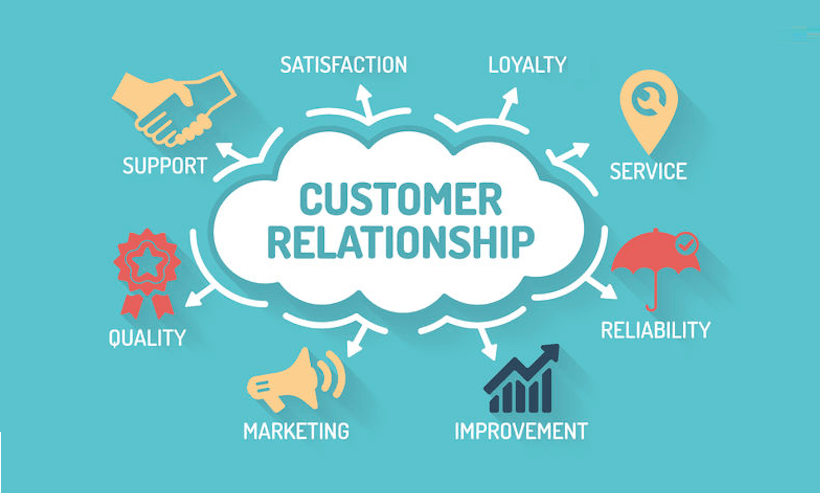
What is it?
A Customer Relationship Management system is defined as being “…technology for managing all your company’s relationships and interactions with customers and potential customers,” according to Salesforce – the industry’s leading CRM solution provider.
“The goal is simple: Improve business relationships to grow your business. A CRM system helps companies stay connected to customers, streamline processes, and improve profitability.
When people talk about CRM, they are usually referring to a CRM system, a tool that helps with contact management, sales management, agent productivity, and more. CRM tools can now be used to manage customer relationships across the entire customer lifecycle, spanning marketing, sales, digital commerce, and customer service interactions.
A CRM solution helps you focus on your organization’s relationships with individual people — including customers, service users, colleagues, or suppliers — throughout your lifecycle with them, including finding new customers, winning their business, and providing support and additional services throughout the relationship.“
Integrating Third Party Applications with a CRM
During my time as a Marketing Manager for a company called StorExcel (now Chesapeake Systems, via acquisition), I was able to successfully integrate several third party applications, including iContact – an email marketing tool, with Salesforce. The main takeaway I want to provide in this post, is that anyone that knows what they want to accomplish with their CRM, can do so via the right “Out of the box” CRM option selection alongside the appropriate application integration configuration(s), which are relatively affordable and easy to implement. Having said that, this takeaway does come with some pre-requisites, including:
- An Understanding of what you want your CRM to do
- An Awareness of what your CRM options are
- Determination that your CRM Goals can be met via a simple/affordable application programming interface (API), with the right focus
- Due diligence in weighing, evaluating (via testing) your CRM-driven workflow options
- Follow-through of your CRM-driven workflow option of choice, via consistent and resilient execution
What do you want your CRM to do?

The capabilities of CRM systems are limitless. That said, the process of integrating applications for your CRM starts with determining what your current and future CRM goals are, then determining what CRM is right for you. CRMs are traditionally known for providing organization’s with an ability to make forecasting simpler and more accurate with a better view of their sales pipeline. “Marketers can use a CRM solution to manage and optimize campaigns and lead journeys with a data-driven approach,” just as I had as a Marketing Manager for StorExcel, in the third party integration example above, which included leveraging iContact’s email statistic tracking capabilities.
“Though CRM systems have traditionally been used as sales and marketing tools, customer service and support is a rising segment of CRM and a critical piece in managing a holistic customer relationship. Today’s customer might raise an issue in one channel — say, Twitter — and then switch to email or telephone to resolve it in private. A CRM platform lets you manage the inquiry across channels without losing track, and gives sales, service, and marketing a single view of the customer to inform their activities. The ability to connect these three functions, and the teams that deliver them, on one platform and with one view to the customer, is invaluable for delivering relevant, connected experiences.”
Awareness of CMS Options
There are certainly benefits to an industry-leading CRM like Salesforce, over other CRM software provider alternatives, including adding new functionalities and integrations to your site via plug-ins provided by established third party integrators from all over the world, which can be accessed very easily, through the use of the CRM’s native app exchange portal. That said, CRM is a competitive and growing space, with some interesting CRM trends to keep an eye on for 2021, involving integration efforts focused on improving customer experience, in the areas of: artificial intelligence, mobility, and usability, enabling new CRM software leaders to emerge in said areas, as a result.
Enabling your CRM Goals via Focused Determination

It may seem daunting to be able to accomplish your CRM goals, at first, especially if/when you are an entrepreneur or have tasked yourself with creating a process that does not exist, for the first time. Do not be daunted! Be rest-assured that with the right focus, the right CRM implementation is waiting to be configured for you and/or by you.
Due Diligence in Evaluating (via Testing), and Weighing your CRM Options

Determining which of the select few CRM options that remain after your initial selection process, should begin with evaluating which of these options can meet most of your needs “Out of the box” – in order to keep your CRM costs down, as well as avoid unnecessary complexity and/or redundant capabilities with your CRM . This evaluation will typically involve a price/capability trade-off for each CRM option, as well as an audit of what needed capabilities would need to be added via integration of third party applications for each CRM.
In the end, whether your organization likes to be at the front-end of the innovation adoption lifecycle, or prefers to utilize an industry-leading CRM like Salesforce until cutting-edge CRM implementations evolve and their implementations begin to stabilize, each CRM option’s price/capability trade-off will then need to be weighed against each other in order to arrive at the CRM option that is best suited for your CRM goals.
Follow-Through of your CRM Option of Choice, via Consistent and Persistent Execution

Hallelujah! You’ve set up a working CRM configuration, and everything is working. Set it, and forget it, right? Not exactly. You’re going to run into challenges maintaining your CRM execution strategy, with each twist and turn of your CRM execution journey. Ongoing maintenance and TLC with each of your CRM tasks will be needed to stay the course. Not to worry, as no task will be too tall if you pay attention to your ever-changing CRM work environment, and respond accordingly.
Next week, I will discuss why it is essential for organizations to establish an authentic identity which users can relate with, in an effort to optimize a customer’s connected experience.
 Brendan Hukill