What is it?
Deep Learning is based upon building artificial neural networks in order to simulate human brain activity, such that simulated human decision results can be formulated based on a specified number of inputs.
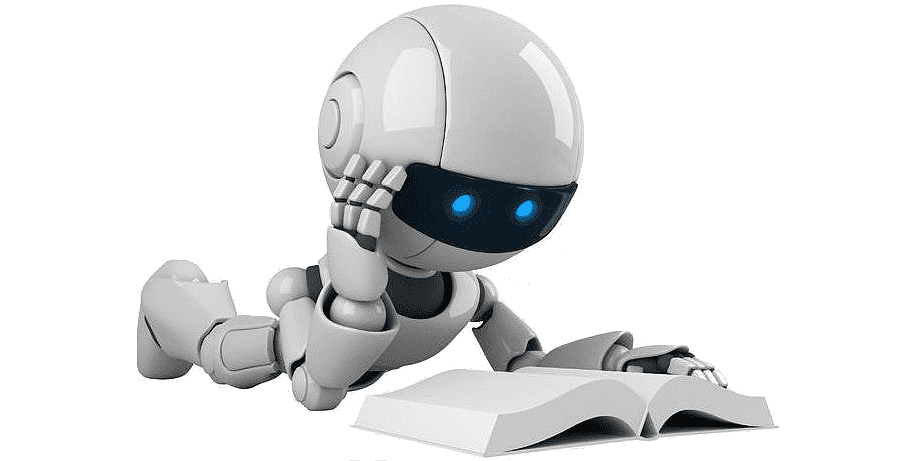
To recap from last week’s post, Deep Learning is defined as being “…a type of machine learning that trains a computer to perform human-like tasks, such as recognizing speech, identifying images or making predictions.” A “Deep Learning” SAS article, which provides additional detail about the technology, states that “Deep learning techniques have improved the ability to classify, recognize, detect and describe – in one word, understand. For example, Deep Learning is used to classify images, recognize speech, detect objects and describe content. Systems such as Siri and Cortana are powered, in part, by deep learning.“
How does it work?
Like animals, our estimator AI’s brain has neurons. They are represented by circles, as shown in the diagram, below.
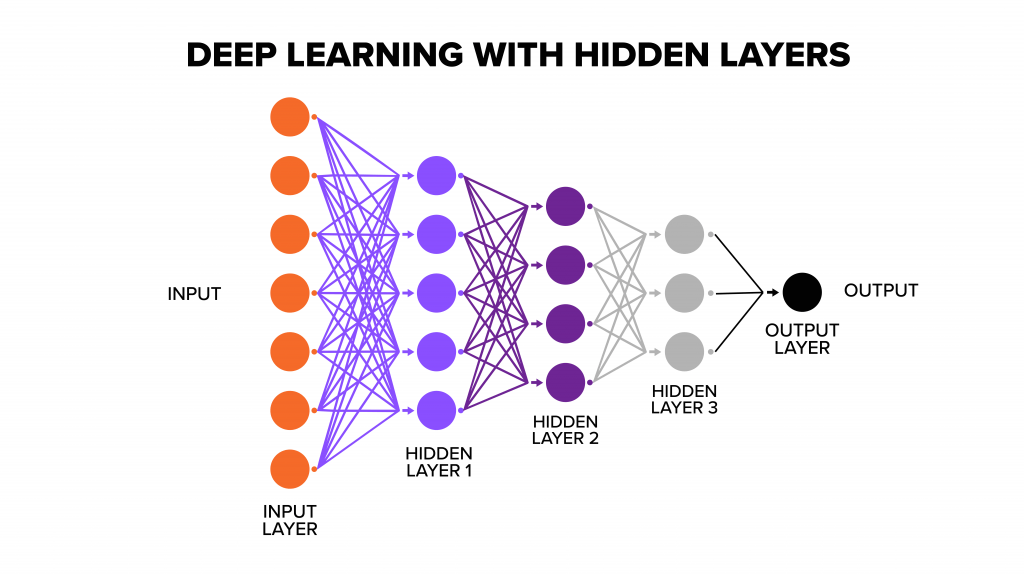
These neurons are interconnected, and are grouped into three different types of layers:
- Input Layer
- Hidden Layer(s)
- Output Layer
To visualize how Deep Learning would work in a real-world scenario, lets take a look at how Deep Learning would calculate an airline ticket price.
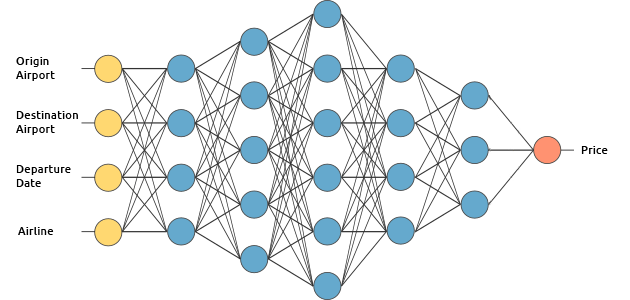
The input layer you see in the diagram above receives input data. In our case, we have four neurons in the input layer: Origin Airport, Destination Airport, Departure Date, and Airline. The input layer passes the inputs to the first hidden layer. The hidden layers perform mathematical computations on our inputs, by treating each neuron as a function, each of which has a weight applied to it based on the perceived importance associated with it. One of the challenges in creating neural networks is deciding the number of hidden layers, as well as the number of neurons for each layer. The “Deep” in Deep Learning refers to having more than one hidden layer. The output layer returns the output data. In our case, it gives us the price prediction.
Hopefully this calculation demonstration provides some insight into how Deep Learning would allow an airline ticket booking website to arrive at a ticket price more accurately than traditional analytical modeling techniques would. For more information on how mathematical calculations such as the one above would be performed in a Deep Learning framework, please visit here.
Why does it matter?
Think about that, from an IoT perspective. Each IoT touch point, including kiosks, digital signage, and especially smart phones, etc., can and will all leverage the ability to better understand an organization’s customer behaviors at each point of digital interaction.
Siri is mentioned as an example implementation which leverages Deep Learning technology, yet Siri is just an example of the tip of the iceberg that exists in today’s IoT touch point implementations, in terms of just how “Deep” the Deep Learning technology can be used to optimizing a customer’s connected experiences in a manner that best aligns with how the human brain operates.
This point of view is underscored by SAS’s “Deep Learning” article as well, which points out that “We have a lot more data available to build neural networks with many deep layers, including streaming data from the Internet of Things.” To borrow a famous line from the classic baseball movie Field of Dreams, I believe it is apropos to summarize this point by saying “If you build it, they will come.” You may be saying, that sounds great, but what do the opportunities to optimize a customer’s connected experience look like, exactly, and how does this get accomplished from a user perspective?

Neural networks have been used for a long time, however, there is great opportunity to improve the applications that use them, in terms of accuracy and performance. Organizations ought to be keeping a pulse on who the leading neural network-driven application developers are, how their applications are currently being used, as well as how their applications COULD be getting used to better serve customers. That is what the opportunities to optimize a customer’s connected experience looks like. The end result is greater personalization capabilities through neural network-driven customer analytics, which is how an organization will accomplish being able to optimize a customer’s connected experience. For example, “SAS experimented with deep neural networks in speech-to-text transcription problems. Compared to the standard techniques, the word-error-rate decreased by more than 10 percent when deep neural networks were applied.”
The paradigm shift which Deep Learning can have on optimizing a customer’s connected experience (when utilizing an organization’s IoT touch points), can be summarized as moving away “…from feature engineering to feature representation,” meaning that the analytic model techniques traditionally used to formulate predictive systems are no longer as efficient as possible towards aligning an organization’s customer engagement strategies with customer behavior, since the models are always changing whenever new customer data is introduced. AI experts suggest that research in the field is trending away from formulating new models to conform with exponential customer data growth, towards a new adaptive customer engagement strategy approach that is provided by Deep Learning. This new approach is believed to “…generalize well, adapt well, continuously improve as new data arrives, and [is] more dynamic than predictive systems built on hard business rules. You no longer fit a model. Instead, you train the task.“
Potential Connected Experience Benefits
Now that the academic part of defining the what and how of Deep Learning is out of the way, how about exploring a couple of real-world applications which may help provide a better understanding of how Deep Learning can be a key that helps an organization unlock the doors which lead to optimizing the connected experience with its customers?
Per SAS’s “Deep Learning” article, “To the outside eye, Deep Learning may appear to be in a research phase as computer science researchers and data scientists continue to test its capabilities. However, Deep Learning has many practical applications that businesses are using today, and many more that will be used as research continues. Popular uses today include:
Speech Recognition
Both the business and academic worlds have embraced deep learning for speech recognition. Xbox, Skype, Google Now and Apple’s Siri®, to name a few, are already employing deep learning technologies in their systems to recognize human speech and voice patterns.
Natural Language Processing
Neural networks, a central component of deep learning, have been used to process and analyze written text for many years. A specialization of text mining, this technique can be used to discover patterns in customer complaints, physician notes or news reports, to name a few.
Image Recognition
One practical application of image recognition is automatic image captioning and scene description. This could be crucial in law enforcement investigations for identifying criminal activity in thousands of photos submitted by bystanders in a crowded area where a crime has occurred. Self-driving cars will also benefit from image recognition through the use of 360-degree camera technology.
Recommendation Systems
Amazon and Netflix have popularized the notion of a recommendation system with a good chance of knowing what you might be interested in next, based on past behavior. Deep learning can be used to enhance recommendations in complex environments such as music interests or clothing preferences across multiple platforms.”
Next week, I will write about Natural Language Processing, one of the four branches of AI technologies as described by the quick AI summary article which I referenced in last week’s post, in an effort to further our familiarity with AI, and better understand the potential customer experience benefits for each one.
 Brendan Hukill
While data mining has caused the commercial works to exploit an individual’s product interests, the downside is an individual being dogged with the resulting exploitation of this information. So there needs to be a check & balance side of AI.
LikeLiked by 1 person